OBJECTIVES: |
Students use a worksheet to compare fresh
water with salt water.
|

|
Jan 20, 2013
Water Cycle: Oceans; Making Salt Water
Jan 17, 2013
let's eat SNACK ATTACK!
20 Delicious Snacks for even your pickiest eaters!
"Mommy I'm hungry, can I have a snack?" Here's my list of great afternoon (or mid-morning) snacks that are simple, quick, and yes yummy. Please make sure to check first to see if they are age-appropriate. AND yes most can be modified to Gluten-Free. Substitute crackers and graham crackers for GF crackers, flour tortillas for corn tortillas, and butter for coconut oil from Trader Joe's (or costco if you have a membership). Feel free to sit with your kiddos at the table and read a Bible story to them about food, too. Like when Jesus fed 5,000 with fish and bread :)
Little Dippers: Cut an apple into wedges. Stick a toothpick in each piece, dip in nut butter, and roll in crushed peanuts or sliced almonds.
Top This: Spread a dollop of blueberry yogurt on a graham cracker and top with banana slices, dried cranberries, and mini-chocolate chips.
Twist it Up: Mix 1/2 cup melted butter with 1/2 cup sugar and 2tsp. cinnamon. Toss to coat one 16oz. bag of mini-pretzels and an 8-oz. bag of nuts. Bake at 350F for 20 minutes.*make ahead and divide into snack bags.
"Mommy I'm hungry, can I have a snack?" Here's my list of great afternoon (or mid-morning) snacks that are simple, quick, and yes yummy. Please make sure to check first to see if they are age-appropriate. AND yes most can be modified to Gluten-Free. Substitute crackers and graham crackers for GF crackers, flour tortillas for corn tortillas, and butter for coconut oil from Trader Joe's (or costco if you have a membership). Feel free to sit with your kiddos at the table and read a Bible story to them about food, too. Like when Jesus fed 5,000 with fish and bread :)
 |
| Magic Wands |
Top This: Spread a dollop of blueberry yogurt on a graham cracker and top with banana slices, dried cranberries, and mini-chocolate chips.
Twist it Up: Mix 1/2 cup melted butter with 1/2 cup sugar and 2tsp. cinnamon. Toss to coat one 16oz. bag of mini-pretzels and an 8-oz. bag of nuts. Bake at 350F for 20 minutes.*make ahead and divide into snack bags.
Jan 16, 2013
The Water Cycle: Discovering How Water is Used by Humans
OBJECTIVES: |
Students use a worksheet to learn about ways
to clean water.
|

|
 |
| Before you begin a little review might need to take place to refresh the vocab words and the water cycle. |
Jan 15, 2013
The Water Cycle: Experiencing Surface Tension
OBJECTIVES: |
Students experiment with water to discover
properties.
|

|
BACKGROUND:After we finished graphing the amount of drops the penny could hold we tried the experiment on a nickel and quarter. But before we tested out the experiment I had my boys guess how many drops each would hold and record their guess in their science lab journals. Each was surprised by how many drops the quarter and nickels held but also thought it was fun to see the end results.Water remains a liquid over a very wide temperature range, namely, a range of 0°C to 100?C, between freezing and vaporization. This spans the temperatures of most parts of the Earth where life can occur.
Water has a very high specific heat, which means that it can absorb or lose much heat before its temperature changes. It takes a lot of energy to start evaporation because water has a high latent heat of vaporization. For this reason, water evaporates slowly from ponds and lakes, where many life forms are dependent on it.
Water is less dense in its solid state than in its liquid state, so that ice floats instead of sinking. This property permits life to develop in polar regions and subpolar regions where ice floats and allows life to continue living below the surface. If ice were heavier than water, it would sink, and more ice would form on top of it. As a result, all life in the waters would be trapped in the ice in the many areas of the world where it gets cold enough to freeze water.
Water's surface tension (the ability of a substance to stick to itself) makes it an excellent substance to float heavy objects upon. Water not only sticks to itself, but also to other surfaces, and this allows it to move against gravity, which is very important to plants when transporting water form the soil to their leaves. This upward motion is known as capillarity or capillary movement.
PROCEDURE: This exercise consists of two parts. First, the students will discover how water flows and secondly, the students will discover how many drops of water they can put on a penny.
In the first exercise give each child two cups. Have them measure 1 cup of water into one cup.
Let them hold both cups and ask them the following questions:
Which cup contains a fluid?
Which cup contains melted ice?
Which cup contains air?
What is the fluid?
- Next ask the students to pour the liquid. Ask them to describe the liquid. The water is flowing; it is a fluid called water.

In the second exercise give each student an eyedropper and penny. First discuss surface tension by using the following illustrations. Surface tension is what allows a water strider (insect) on water not to sink and explains why heavier items in water, float. In this exercise the students will experience surface tension by seeing how many drops of water they can put on a penny with an eyedropper. Ask students to predict how many drops can fit on a penny. You are going to have to illustrate and demonstrate very carefully how to use an eyedropper.

- Using an eyedropper, gently let water drops fall into the center of the penny. Count how many you can put on before the water runs off. (It will be between 20 and 34.) Let the children try this. Their numbers will be lower than yours, and will change depending on whether they are letting the drops fall into the center of the penny or on the edge.
- You may want to extend this lab by seeing how many drops they can place on a nickel. Go over their results. You may also want to repeat the experiment with alcohol. It has a much lower surface tension and will not be able to hold as much liquid.

- The key concept here is to have the students experience surface tension and to be able to observe surface tension when they leave the classroom.


This is really simple lab to show surface tension and can be found at msnucleus.org. Under elementary/water cycle/first grade/experiencing surface tension. Make science a fun part of homeschooling!
Jenna
Jan 14, 2013
The Water Cycle: The Properties of Water
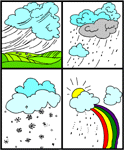 When the word 'SCIENCE' is mentioned in my house all the little ears perk up just as if I said the word 'cookies.' For our third unit (weeks 18-21) of First Grade Science we will be studying the Water Cycle. Its a four week unit consisting in studies of The Properties of Water (week1), Making Salt Water (week 2) Movement of Air (week 3), Reading A Thermometer (week 4). Each week is broken into three parts: a pre-lab, lab, post-lab.
  |
| from msnucleus.org |
Objectives:
- Investigating the water cycle
- Exploring water's three states of matter
 Vocabulary
- evaporation
- gas
- liquid
- precipitation
- solid
- water cycle
- Drippy the Hippie by C. Fries
- scissors
- worksheet
Water circulates in the atmosphere through the water cycle. The water on Earth evaporates (or becomes gas) into a cloud. When the conditions are right, the cloud releases water or precipitation.
Procedure:
1. Discuss the different components of the water cycle by having students sing-along to Drippy the Hippie.
Ok I know, I know this is really chessy, but who cares if your kids learn something and it does not
disagree from Biblical teaching, even if it's granola ;)
2. Make copies of the worksheets for your students. Color the worksheet and cut out the pieces.

3. Have students use the pieces they cut out to make the water cycle. Then go over the components of the water cycle with the students slowly. Evaporation from water forms clouds and then precipitates.


- What is evaporation?
- Is evaporation a gas?
- Name a form of precipitation? hail, snow, rain, or sleet
- Can we drink water from water puddles in the street? Why not?
- Is water that falls from the sky clean?
- Explain the water cycle to me.
Follow along for tomorrow's post on the lab on Water Cycle!
Jenna
Subscribe to:
Posts (Atom)

Popular Posts
-
 Learning About Colors To start simple we learned about primary colors and how to make secondary colors out of primary colors with tempu...
 -
 Well I have to admit that our school days are quickly filled with many things to do and blogging falls to the end of that list. That being ...
 -
 Breakfast: Mighty Muffins Ingredients: 1/2 cup sugar (premium pure cane sugar) 1/2 cup applesauce 1 1/2 cups milk (coconut, soy...
 -
 December 's Here Hooray! First I have to say that I love, Love, LOVE Christ mas S eason. In my home the countd own to Christmas sta...
 -
 Hi everyone! I hope the holiday season is bringing you joy! Every so often I look through magazines and see really great crafts for the ...
 -
 The boys love cars and they love to build so what better than to combine the two? Well these are great little wind-up cars and a race trac...
 -
 Christmas Card C raft: Using craft holiday paper let your kids creat e a few C hristmas cards for their closest friends and family. L et ...
 -
 Learning the Letter F It has taken a little time but my little engineer is finally starting to 'like' school. He says, "Let...
 -
 Well it looks as though my husband might embark on a home improvement project-finishing our walk-up attic but until then WE will be using ...
 -
 Day 3: Pyramids · Build a pyramid out of sugar cubes (student can build whichever type they desire ) Lap Book: L...