Ads 468x60px

Labels

Showing posts with label First Grade. Show all posts

Feb 22, 2013

Test Prep Smart Parents

Good Day readers! As March is quickly approaching I find myself beginning to think about testing my first grader to evaluate where we are in our education journey. Now I understand that a lot of homeschoolers do not agree with testing and believe testing to be one the reasons they dislike public education. Please know that I agree that Standardized testing puts every unique child into a box and should that child have a different way of learning and responding to learning then testing doesn't adequately show what your child may actually know. However, there is a positive side to homeschool testing. If you're a homeschool parent like myself then some form of validation is needed from time to time. One form of validation can be achieved through testing. Also the benefit of testing at home means a parent is sitting next to their child and baby-stepping their way through the process together so come REAL test time they are equipped for the real McCoy ;)

Why do I agree with practice testing?
Practicing basic skills in a testing situation can help ensure that your students:
  • are comfortable with the testing environment
  • know how to approach different kinds of test questions
  • apply knowledge to a variety of test formats
  • use time wisely during tests

Jan 29, 2013

Superbowl Countdown Week Packets!

Superbowl Packets for Oodles of Fun Learning this Week!
Hi folks! To shake things up a little bit this week be are beginning a new theme: Football. Every subject themed around football. Why football? For me, football is not that big a deal but the Superbowl is this Sunday and having two boys I thought it would a fun way to integrate two things they like sports and school. Therefore we are using two football packets created by some awesome and very talented first grade teachers!

First a unit I found created by Katie King. She's actually had a give-away but I didn't win. Never-mind that you can buy this unit with over 40 pages of work in the subject of math for $5 bucks! Check it out! We're also using another unit-pack with activity centers and printables created by Kelley's Fantastic Football Packet
See how awesome and creative the cover page is? But wait there's more!

Each day your student will be up to their ears in fun learning games that keep their attention and as all teachers know keeping their attention is hard but crucial ;)
 This unit pack includes:
  • Half Time Snack (counting coins)
  • Line 'Em Up! (non-standard measurement practice)
  • Keeping An Eye of the Clock (Time to the Half Hour)
  • Rah Rah Skip Counting (2s, 5s, 10s)
  • Place Value Match-Up! (Place Value and Greater Than/Less Than)
AND Printables
  • 5 Speed Drills
  • Place Value
  • Greater Than/Less Than
  • Even/Odd
  • Subtraction
  • Skip Counting 2s, 5s, 10s


And if that's not enough there are even more GREAT units you can easily printout for your students all in support of teachers. Check them out.

Enjoy a fun week with a different kind-of unit topic.
Jenna


Jan 22, 2013

Water Cycle: Oceans

POST LAB
OBJECTIVES:
  • Exploring how the oceans became salty.
  • Discovering the components of salt water.
VOCABULARY:
  • elements
  • erosion
  • evaporation
  • oceans
  • salt 
(I highly recommend using a children's dictionary to go over vocabulary words so they clearly understand each word)
MATERIALS:

Jan 20, 2013

Water Cycle: Oceans

Dissolving Salt in Water
OBJECTIVES:
  • Dissolving salt in water.
  • Observing how salt crystals form.
VOCABULARY:
  • evaporation
  • salt
MATERIALS:
  • salt 
  • Epsom salt
  • trays
  • warm water
  • pan
  • rope-like string (mop string) 
  • measuring beakers
  • two jars or beakers. 
Students experiment with salt crystals.

Water Cycle: Oceans; Making Salt Water

OBJECTIVES:
  • Comparing fresh and salt water.
  • Discovering bodies of fresh and salt water.
VOCABULARY:
  • fresh water
  • ocean water
MATERIALS:
Students use a worksheet to compare fresh water with salt water.

Jan 16, 2013

The Water Cycle: Discovering How Water is Used by Humans

OBJECTIVES:
  • Exploring components of water.
  • Discovering how water is used by humans.
VOCABULARY:
  • hydrogen
  • oxygen
  • water
MATERIALS:
 
Students use a worksheet to learn about ways to  clean water.
Before you begin a little review might need to take place to refresh the vocab words and the water cycle.

Jan 15, 2013

The Water Cycle: Experiencing Surface Tension

OBJECTIVES:
  • Discovering properties of water. 
  • Experiencing surface tension.
VOCABULARY:
  • flow
  • fluid
  • surface tension
  • water
MATERIALS:
Students experiment with water to discover properties.
 
BACKGROUND: Water remains a liquid over a very wide temperature range, namely, a range of 0°C to 100?C,  between freezing and vaporization.   This spans the temperatures of most parts of the Earth where life can occur.

Water has a very high specific heat, which means that it can absorb or lose much heat before its temperature changes. It takes a lot of energy to start evaporation because water has a high latent heat of vaporization.  For this reason, water evaporates slowly from ponds and lakes, where many life forms are dependent on it.

Water is less dense in its solid state than in its liquid state, so that ice floats instead  of sinking.  This property permits life to develop in polar regions and subpolar regions where ice floats and allows life to continue living below the surface.  If ice were heavier than water, it would sink, and more ice would form on top of it.  As a result, all life in the waters would be trapped in the ice in the many areas of the world where it gets cold enough to freeze water.
Water's surface tension (the ability of a substance to stick to itself) makes it an excellent substance to float heavy objects upon.  Water not only sticks to itself, but also to other surfaces, and this allows it to move against gravity, which is very important to plants when transporting water form the soil to their leaves.  This upward motion is known as capillarity or capillary movement.
PROCEDURE: This exercise consists of two parts.  First, the students will discover how  water flows and secondly, the students will discover how many drops of water they can put on a penny.
  1. In the first exercise give each child two cups.  Have them measure 1 cup of water into one cup.
    Let them hold both cups and ask them the following questions:
    Which cup contains a fluid?
    Which cup contains melted ice?
    Which cup contains air?
    What is the fluid?
     
  2. Next ask the students to pour the liquid.  Ask them to describe the liquid.  The water is flowing; it is a fluid called water.
      
  3. In the second exercise give each student an eyedropper and penny.  First discuss surface tension by using the following illustrations. Surface tension is what allows  a water strider (insect) on water not to sink and explains why heavier items in water, float.  In this exercise the students will experience surface tension by seeing how many drops of water  they can put on a penny with an eyedropper.  Ask students to predict how many drops can fit on a penny.   You are going to have to illustrate and demonstrate very carefully how to use an eyedropper.
      
  4. Using an eyedropper, gently let water drops fall into the center of the penny.  Count how many you can put on before the water runs off.  (It will be between 20 and 34.)  Let the children try this.  Their numbers will be lower than yours, and will change depending on whether they are letting the drops fall into the center of the penny or on the edge.
      
  5. You may want to extend this lab by seeing how many drops they can place on a nickel.  Go over their results.  You may also want to repeat the experiment with alcohol.  It has a much lower surface tension and will not be able to hold as much liquid.
      
  6. The key concept here is to have the students experience surface tension and to be able to observe surface tension when they leave the classroom.  
After we finished graphing the amount of drops the penny could hold we tried the experiment on a nickel and quarter. But before we tested out the experiment I had my boys guess how many drops each would hold and record their guess in their science lab journals. Each was surprised by how many drops the quarter and nickels held but also thought it was fun to see the end results. 

This is really simple lab to show surface tension and can be found at msnucleus.org. Under elementary/water cycle/first grade/experiencing surface tension. Make science a fun part of homeschooling!

Jenna

Jan 14, 2013

The Water Cycle: The Properties of Water

When the word 'SCIENCE' is mentioned in my house all the little ears perk up just as if I said the word 'cookies.' For our third unit (weeks 18-21) of First Grade Science we will be studying the Water Cycle. Its a four week unit consisting in studies of The Properties of Water (week1), Making Salt Water (week 2) Movement of Air (week 3), Reading A Thermometer (week 4). Each week is broken into three parts: a pre-lab, lab, post-lab.
from msnucleus.org
Today's post is just about week 1: The Properties of Water Pre-Lab

Objectives:
  • Investigating the water cycle 
  • Exploring water's three states of matter
Vocabulary
  • evaporation
  • gas
  • liquid
  • precipitation
  • solid
  • water cycle   
Materials:
The hydrologic or water cycle is a major driving force on Earth. Water is important to our everyday lives. First grades see water all around them, but many do not realize its importance. Ask students if we can survive without food or water longer. They are usually amazed that humans can survive without food much longer than water. Humans can only last about three days without water. At that time our kidneys will no longer function, and we will not be able to get rid of the wastes that accumulate in our bodies. Our bodies require fresh clean water to survive. Polluted or salty water will not help our bodies-God made us this way!

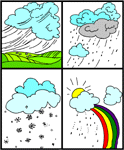
Water circulates in the atmosphere through the water cycle. The water on Earth evaporates (or becomes gas) into a cloud. When the conditions are right, the cloud releases water or precipitation.

Procedure:
1. Discuss the different components of the water cycle by having students sing-along to Drippy the Hippie.   
Ok I know, I know this is really chessy, but who cares if your kids learn something and it does not 
disagree from Biblical teaching, even if it's granola ;)

2. Make copies of the worksheets for your students. Color the worksheet and cut out the pieces. 
   
 3. Have students use the pieces they cut out to make the water cycle. Then go over the components of the water cycle with the students slowly. Evaporation from water forms clouds and then precipitates.

Review by asking a few questions:
  • What is evaporation?
  • Is evaporation a gas? 
  • Name a form of precipitation? hail, snow, rain, or sleet
  • Can we drink water from water puddles in the street? Why not?
  • Is water that falls from the sky clean?   
  • Explain the water cycle to me.
All of this and more units can be found at msnucleus.orghttp://www.msnucleus.org/membership/index.html

Follow along for tomorrow's post on the lab on Water Cycle!
 Jenna   

Dec 6, 2012

Egypt Unit Study Day 4 & 5


Day 4: Egyptian Geography
·         
      Use atlas and globe to locate Africa and Egypt. Discuss what type of landscape is there ie desert, oasis, delta, palm trees, etc.
·         
       Lap Book: Word Scramble; cut out the letters to the words: delta, oasis, tomb, desert, pyramid, and sun. Paperclip the letters together and store in pocket. Have student pull out letters and work on one word at a time, give hints if needed.

Nov 30, 2012

Night Sky Adventure In ACTION!

Hello Readers! Well if you didn't see my invitation post before here's more about the great fun our eldest son and husband had on their "Night Sky Adventure" trip learning about stars, constellations, and beavers. AND because I wasn't actually the parent who went to the event I'd like to give a warm welcome to my guest blogger on THIS POST for the first time ever! Here's what my husband and Junior learned.

Nature Center
Junior and I headed over to the North Chagrin Nature Center this evening to meet up with some other homeschooling kids and their parents to learn about planets, stars, and constellations.  Inside the nature center we got to crawl into a portable planetarium.  In the planetarium we got to see how stars travel across the night sky, and we learned about the northern and southern hemisphere.  Junior learned that there are 88 constellations in the night sky and the "Big Dipper" is actually not a constellation but rather a small part of the Ursa Major (The Great Bear) constellation.
Cutting out the Constellation Finder

After the planetarium it was time for our constellation finder craft.  Basically it's a wheel that rotates from month to month.  Based on the month the finder will show you the position of the constellations in the night sky.

Heading to the trail
Next it was time for our nature walk around the Sanctuary Marsh to see what kind of planets and stars we could spot in the sky.  I must say this was the coolest part. When we arrived at the nature center the sky was cloudy and I didn't think we'd see anything, but sure enough when we headed out the clouds had rolled out and we got to see Jupiter, the Little Dipper, and the North Star.


Google map screen shot

Junior loved the Google Sky Map that I downloaded to my phone.  We where able look up at the night sky and see all of Gods creations.


Hot chocolate to finish the night was a great treat.


My first real homeschooling adventure with Junior and it was a success.  I look forward to the next one.

Junior's Dad

Nov 29, 2012

Outdoor Education for Homeschoolers!


Hey Cleveland Homeschoolers! Join us for:

"Outdoor Education for Homeschoolers: Night Sky"
Fri, November 30, 6pm – 8pm
North Chagrin Nature Center

Join Naturalist Angelec Hillsman as we gaze at the night sky. Discover the wonders of the fall night sky through star watching, storytelling and SkyLab, an indoor planetarium. We’ll also make a craft, walk under the beaver moon and more.
Ages: 6 – 12 years
Fee: $3
Terrain: easy, level, 1 mile

Registration is required. Register by calling 440-473-3370.


Love to See You There!!!

Jenna

Nov 15, 2012

10 Penny Activites to Liven Up Learning!

10. How Many Pennies Did I Grab.
Use a 100 number chart (you can make the chart with construction paper, pen, and straight edge) and basket full of pennies. Have your student grab a handful of pennies and guess how many they grabbed. Then have them spread out the pennies, starting at #1, on the number chart. What number did they end on?

9. Flip Flop Which One is on Top? 
Make a simple grid graph on a sheet of paper with two columns. Label each column heads/tails. Give each student one penny. Have them flip the penny 25 times and check the column it lands on. Then asks questions about your graph results.

8. A Balancing Act

Take two bowls and a handful of pennies. Have student drop half their handful into one bowl and the rest into the other bowl. Then have them count the number in each bowl. Ask which bowl has greater/lesser number. Then ask them to even out the number by adding or subtracting pennies to make the bowls even. If you end up with an uneven number ask them to leave one penny out so the bowls are even.

7. Guess the Hidden Number

Take out a 100 number chart and cover some numbers with pennies. Then have your student count until they hit a covered number and guess what number they think is covered up based on the last and next number they see. Have older students count backward from 100.   

6. Which Stack is Higher, Lower, First, Second, Third, Last?

Take an egg carton and put different amounts of pennies in 5 different cups. Have them guess how many they think are in each "cup." Ask students to take pennies out one at a time and make  stacks out of pennies.(Make sure you have 5 different amounts. Then ask your student to identify the stack with the most/least/equal. Then have them put the stacks in order from most to least. 

5. Double Down

Take 24 pennies and put on a pile on the ground and have student count them. Then have them divide the pile into 2 piles of 12 removing one penny at a time to the new pile. Then count and divide the 12 pennies in the two new piles and so on until you cannot divide anymore. For older kids do the activity with a larger number to begin such as 64.

4. Many Years of Pennies

Take 15 pennies and have student put them in order from oldest to newest in the years they were made. Again to make more complicated have student put them in decades first then by the year using more pennies.

3. How Many Penny-Pennies Does it Take?

Draw a line on a clear cup or mason jar (ie a kids throw-away dixie cup or a mason jar). Have your student guess and write down how many pennies it will take to fill up the jar/cup. Add pennies while counting how many it takes. See how close their guess was. Then give the pennies to your kiddos to save.

2. Pennies Per Pages!

Take out your child's favorite book (the bigger the book the more pennies you'll need:) As you read the book put a penny in each page then when done add the number of pennies you needed for each page of the book.

1. My Lunch Costs How Much?

Pre-make a lunch ie. sandwich, fruit, veggie, chip, drink with multiple options. Put each item in a lunch baggie and a price on each bag (all 5cents or less). Take a brown paper bag and have student write their name on it. (you can use anything to put their "purchase" in) Give your student 25cents and tell them they are going to buy their lunch today. Have them pick out which items they'd like to buy and talk about the importance of a balanced diet. Have them pay for each item.  If they have any money left teach them about the value of saving for tomorrow or the future. While going through the process ask questions about adding and budgeting so they can afford all the things they wish to eat. For older kids explain how adults need to budget and plan for their cost of food whether at home or for the working parents who go out lunch during the work week. 

Playing with pennies can help teach kids the value of math, and how math and money relate to the outside world. It also widens their perspective on how to use pennies to learn in many ways. Have fun and remember kids learn in stages so once they master a simpler penny game move on to a more difficult one.


Happy Homeschooling,

Jenna 

Related Posts Plugin for WordPress, Blogger...

Popular Posts


A Mother's Prayer

Lord bless my home and anyone who enters. Lead me daily so that I am always aware of You! Whether educating my kids, cooking or cleaning may my attitude always be that of a servant. Give me the words to guide my children to You, to know You, Your character and love You, Lord. Please teach to have patience and to always be learning. Lord mold me through each stage of life so I am continually growing and pursuing You no matter what. Lord I want to be a great mom and wife and I know that if I look only to You for help that I can accomplish this, the love for my family that I desire to show them. Lord I'm amazed by You and I love You. Amen.

Full of Life, Full of Love

"The spirited child-often called "difficult" or "strong-willed"--possesses traits we value in adults yet find challenging in children. Research shows that spirited kids are wired to be "more"-by temperament, they are more intense, sensitive, perceptive, persistent, and uncomfortable with change than the average child." It seems as though we have three, and they are very much like me. What does this mean? I need to be compassionate, consistent, confident, controlled, all with a gentle yet firm approach. Yes my plate is full.

Motherhood: A rigorous training ground

What an awesome responsibility mothers have to their children. Cultural stereotypes promote the idea that giving birth miraculously endows women with kindness, compassion, and goodness. But we all know better. Many of us can witness that we are made more aware of our weaknesses and impatience after becoming mothers than we were before. Godliness and generosity are not prerequisites of giving birth; they are characteristics that God hones and whittles into our character over time. Motherhood provides a rigorous training ground where we can display practice and model the disciplines of love, honesty, and compassion before our children. --Rebecca Laird